 www.U-35.com
The Homepage for U-35, a Type VII U-Boat
... 1936 - 1939 ...
|
|
|
|
|
|
|
U-35 was assigned Feldpost Number M 21 203 (address for postal mail). [3]
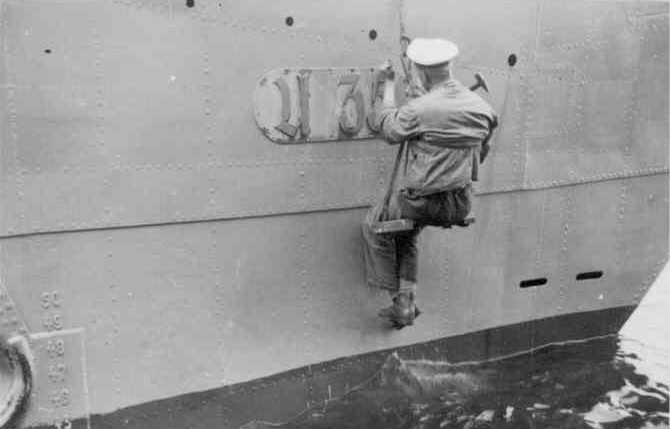 Otto Wagner removing identification from
U-35
prior to the first war patrol. [55,72]
Otto Wagner removing identification from
U-35
prior to the first war patrol. [55,72]
|
First War Patrol
09 September 1939 - 12 October 1939.
On 09 September, U-35 was unsuccessfully attacked by the British
submarine HMS Ursula (Lt Cdr G C Phillips) in the Heligoland
Bight.
U-35 stopped and searched vessels in strict compliance the Prize
Regulations and always made sure of the safety of the crews.
U-35 allowed the first British ship it encountered in the North Atlantic, the fishing trawler ALVIS, to pass on 18 September 1939, after realizing that the thirteen man crew could never have reached land in the available lifeboat; in return, the British captain warned U-35 that the Royal Navy aircraft carrier Ark Royal was in the general area. Click here for more details on the ALVIS.
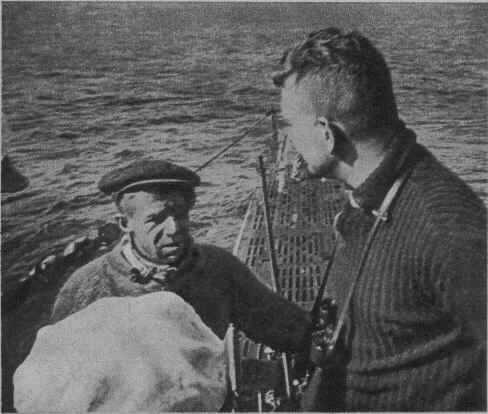 On board U-35, Werner Lott (right)
with the master of ALVIS, Albert E.
Thomason. [32]
On board U-35, Werner Lott (right)
with the master of ALVIS, Albert E.
Thomason. [32]
|
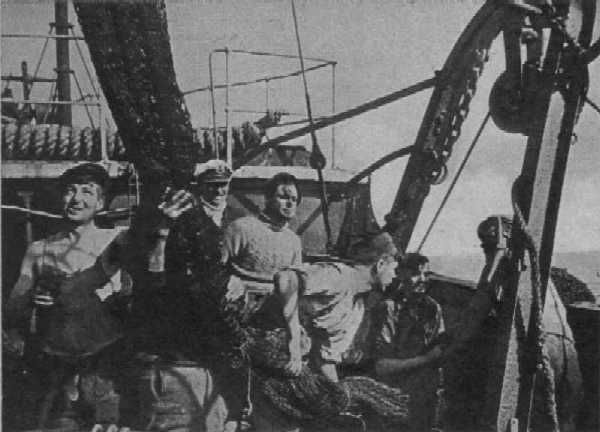 U-35 Prize officer Heinz Erchen on board
the ALVIS during the first war patrol.
Albert E. Thomason is recognizable on the left. [32]
U-35 Prize officer Heinz Erchen on board
the ALVIS during the first war patrol.
Albert E. Thomason is recognizable on the left. [32]
|
Click here for more details on the ARLITA.
Click here for more details on the LORD MINTO.
Click here for more details on the NANCY HAGUE.
On 21 September 1939, U-35 made the second convoy attack of the war, when she torpedoed and damaged the British tanker TEAKWOOD (6014t), from convoy OA 7, SW of the Scillies.
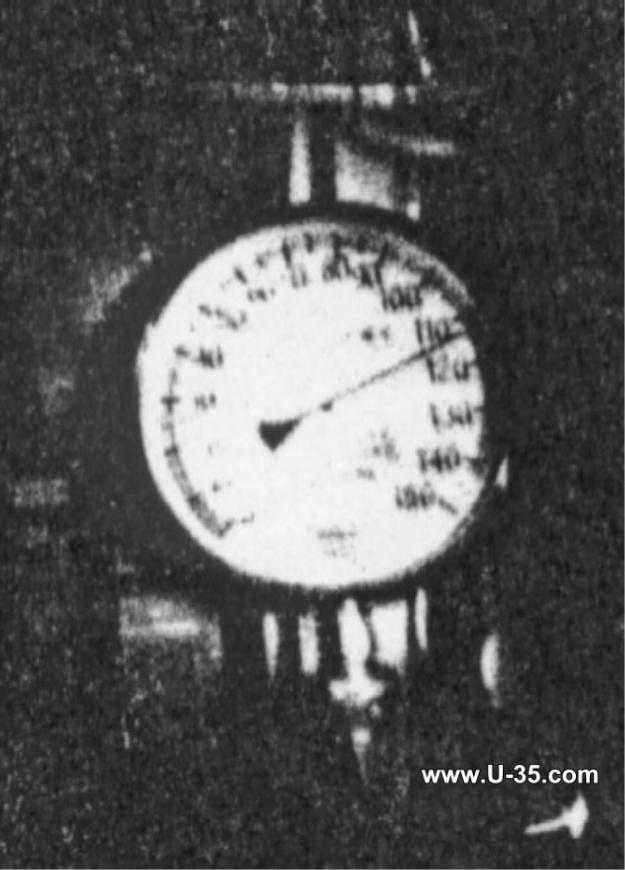 Later,
U-35 was attacked by a British destroyer. Only one depth charge was
dropped (because, said the escort captain, contact was doubtful). That depth
charge was so accurately placed that it knocked out one of
U-35's periscopes and put the blower system out of action. U-35
bottomed out at 115 meters (377 feet), deeper than its design depth. Down there
repairs were made, although the valves began to leak from the pressure. The
Chief Engineer, Gerhard Stamer, and also
Theodor Schütt, were awarded the Iron Cross (second class) for that
on 12 October 1939.
Later,
U-35 was attacked by a British destroyer. Only one depth charge was
dropped (because, said the escort captain, contact was doubtful). That depth
charge was so accurately placed that it knocked out one of
U-35's periscopes and put the blower system out of action. U-35
bottomed out at 115 meters (377 feet), deeper than its design depth. Down there
repairs were made, although the valves began to leak from the pressure. The
Chief Engineer, Gerhard Stamer, and also
Theodor Schütt, were awarded the Iron Cross (second class) for that
on 12 October 1939.
On 30 September 1939, U-35 measured the blacked-out profile of the forty-five-thousand ton passenger liner AQUITANIA in its sights at a range of only five hundred meters, but respected the restriction on attacking such vessels (which, ironically, had already been lifted, though this had not yet been communicated to U-35) and allowed her to proceed unmolested.
On 01 October 1939, U-35 torpedoed and sank the SUZON, a Belgian steamer of 2239t, near Ushant:
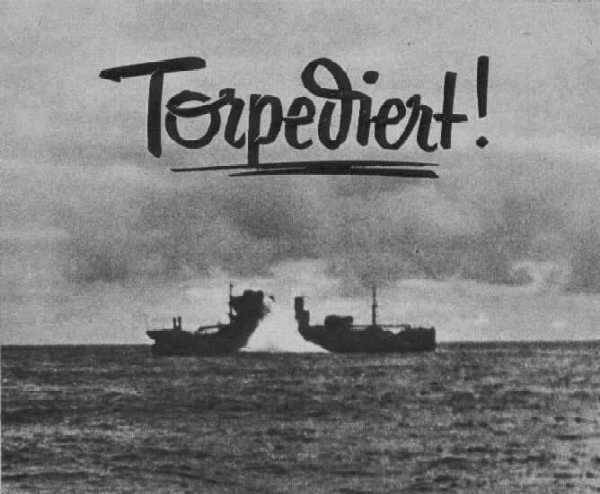 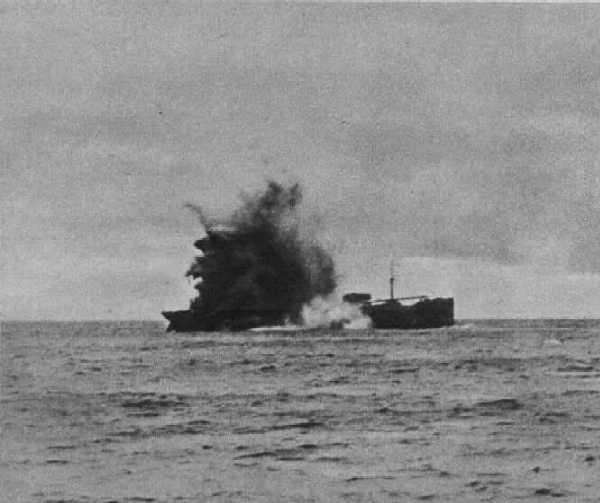 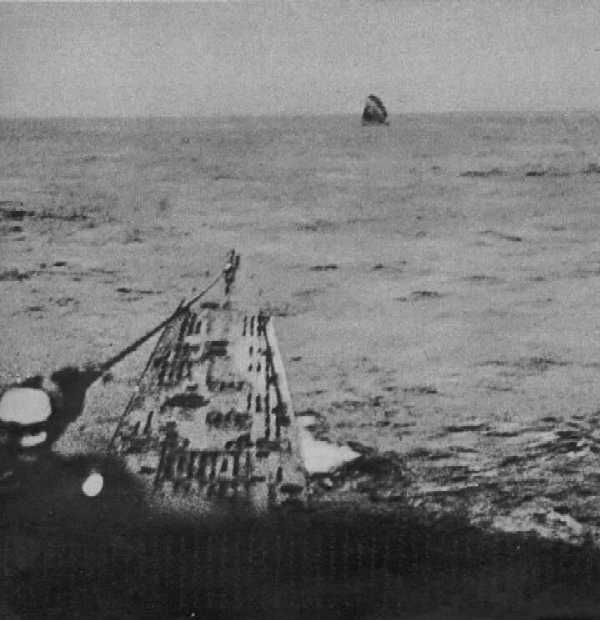 [32] [32]
|
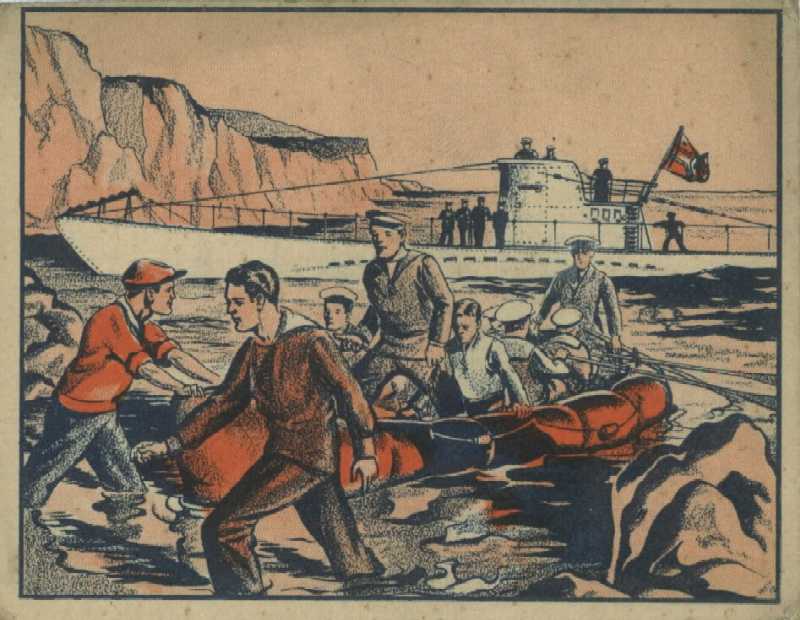
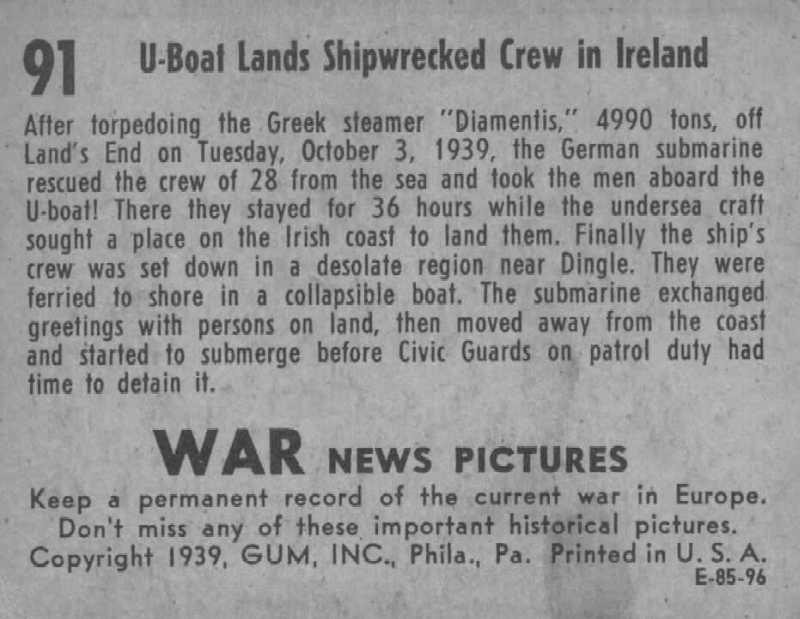
On 03 October 1939, U-35 sighted the Britain-bound DIAMANTIS, a Greek steamer of 4990t, 40 miles west of Scillies off Lands End. U-35 surfaced in bad weather and warned those aboard that their ship was about to be sunk. As the sea was rough and unsuitable for normal lifeboat operations, the crew of 28 men were taken aboard U-35.
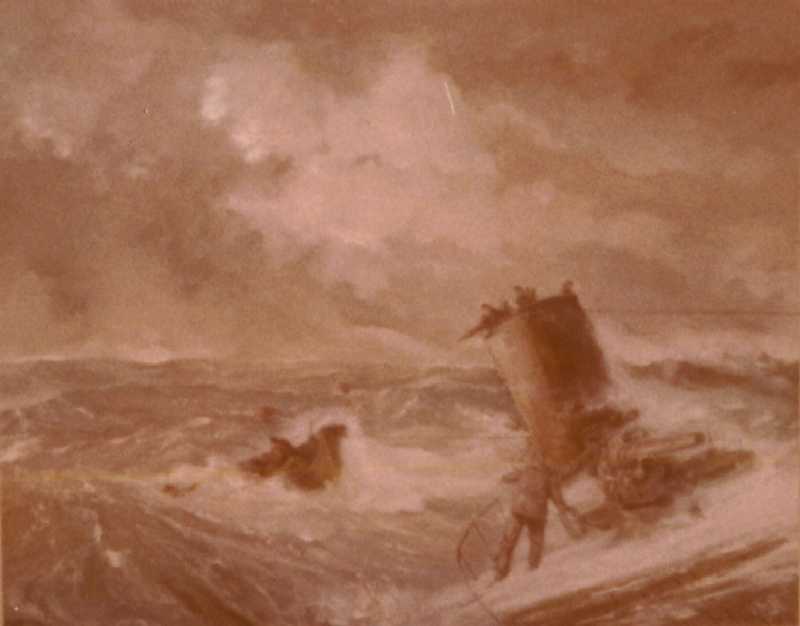 Rescue
of the DIAMANTIS crew; painting by Heinz
Pfeifer.
Rescue
of the DIAMANTIS crew; painting by Heinz
Pfeifer.
In the late afternoon of October 4th, after 30 to 35 hours on board, the Greeks were landed in Dingle Bay, in neutral Ireland, on a beach lined by local people. U-35 crew member Walter Kalabuch rowed the Greeks, several at a time, from the U-boat to the shore (He was awarded the Iron Cross, second class, for this on 12 October 1939). When all were ashore U-35 left slowly on the surface, watched by onlookers until it disappeared into the fog.
|
U-35
was featured on the cover of
the American magazine LIFE
on 16 October 1939, and the
Diamantis
incident is mentioned. Upper left is Obersteuermann Walter Arnaschus.
For this show of compassion, Kptlt. Werner Lott,
the commander of
U-35, was later rebuked by the U-Boat command for putting his U-Boat and
crew in danger. [4,5,23,25,38,42]
At dawn on 29 November 1939, U-35 was cruising on the surface east of the
Shetland Islands, 60.53N X 02.47E in the North Sea. The British Destroyer
HMS ICARUS (Lt Cdr C D Maud) saw
U-35 and turned to attack. U-35's sighting of HMS ICARUS
was nearly simultaneous. U-35 crash-dived and went deep - to 229
feet - and steered evasive courses. As the Asdic on HMS ICARUS was not
functioning, depth charges set for 250 feet were dropped in order to feign an
attack. Two other destroyers, HMS KINGSTON (Lt Cdr P Somerville)
and HMS KASHMIR (Lt Cdr H A King), responded to HMS ICARUS's
alert; all were under the direction of Captain Lord
Louis Mountbatten aboard the HMS KELLY. Directed by HMS ICARUS
to the likely spot, HMS KINGSTON
was able to establish ASDIC contact and made two depth-charge attacks, which
jammed the diving planes of
U-35 and put her at a sharp up angle. In an attempt to bring the bow down
and regain control of the boat, all available men were rushed to the forward
torpedo room.
U-35 was put on full speed, but in vain. The depth charges had also
ruptured fuel and ballast tanks aft and no amount of weight forward could level
the boat.
U-35 was suddenly on the surface, and the crew was ordered to abandon
ship into the terribly cold water. HMS KASHMIR fired a warning shot above
U-35.
HMS KASHMIR fished several officers and twenty-seven men from the icy
water.
HMS KINGSTON picked up Kptlt. Werner Lott
and eleven others. The entire crew of 43 survived.[4,5,6,19]*
On board HMS KINGSTON, Kptlt. Werner Lott
entered the following note in the wardroom visitor's book: "Wishing you the best
of luck except against German U-Boats" [38,49]. HMS ICARUS, HMS KINGSTON and HMS KASHMIR issued formal
reports to the Admiralty in December 1939. These reports, along with related
reports and awards messages, are available for viewing here (www.U-35.com/sources/hmships.htm). The
Anti-Submarine Warfare reports issued in November and December 1939 are
available for viewing here
(www.U-35.com/sources/aswreports.htm).
2021-02-22
 "LIFE'S COVER: The German submarine U-35, shown on the cover, distinguished
itself last week by bagging a Greek steamer and bringing the survivors to
the Irish shore. It is a 500-tonner built three years ago at Krupp's
Germania yards at Kiel and flies the Nazi war flag with a red field. It is
painted gray on the sides to blend with the sky and black on top to blend
with the water when submerged. The rows of round holes are the intakes for
induction valve. You are looking forward from about midships."
"LIFE'S COVER: The German submarine U-35, shown on the cover, distinguished
itself last week by bagging a Greek steamer and bringing the survivors to
the Irish shore. It is a 500-tonner built three years ago at Krupp's
Germania yards at Kiel and flies the Nazi war flag with a red field. It is
painted gray on the sides to blend with the sky and black on top to blend
with the water when submerged. The rows of round holes are the intakes for
induction valve. You are looking forward from about midships."
The DIAMANTIS incident is described in
more detail on a separate page (click to view)
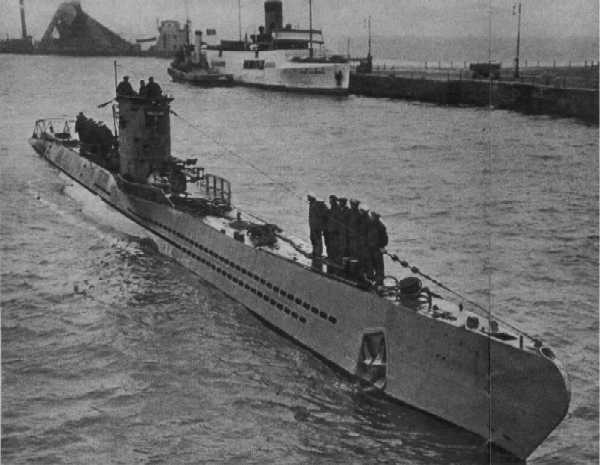 U-35 returning to Wilhelmshaven from the first war patrol. [32]
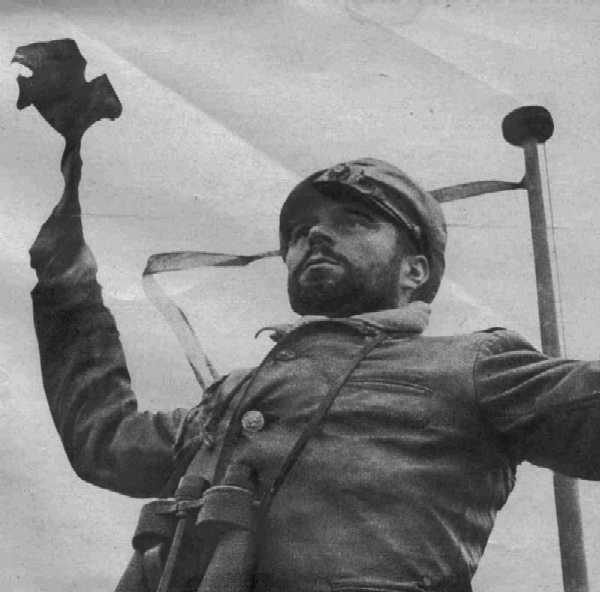 Willi Dietrich in front of the homeland
pennant. [32,33]
Willi Dietrich in front of the homeland
pennant. [32,33]
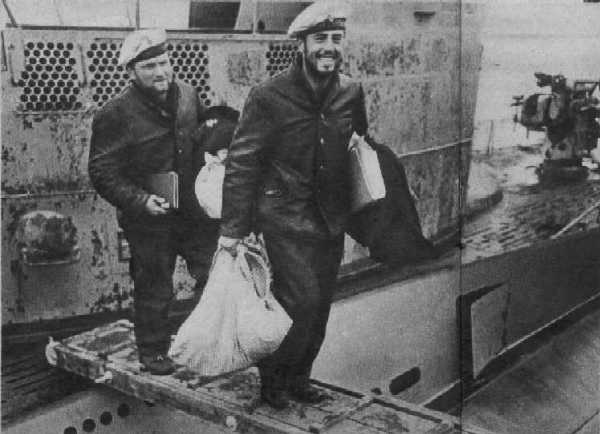 Wilhelm Janssen and
Paul Liebau depart
U-35. [32,33]
Wilhelm Janssen and
Paul Liebau depart
U-35. [32,33]
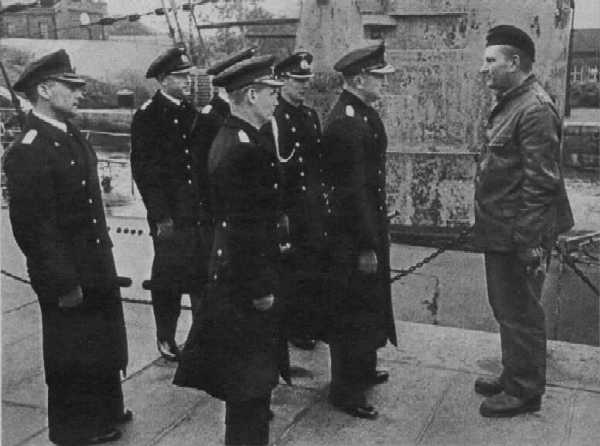 Werner Lott, the commander of U-35, being
addressed by Admiral Karl Dönitz
and staff, upon return from the first war patrol. U-35 in background.
[32]
Werner Lott, the commander of U-35, being
addressed by Admiral Karl Dönitz
and staff, upon return from the first war patrol. U-35 in background.
[32]
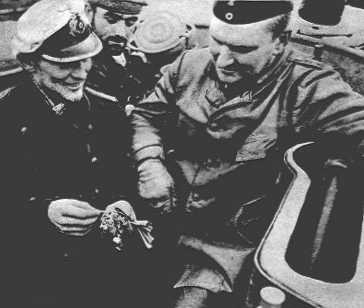 Heinz Erchen,
Karl Schnute, and Werner Lott (right)
inspecting crosses awarded by the Kriegsmarine. [32,33]
Heinz Erchen,
Karl Schnute, and Werner Lott (right)
inspecting crosses awarded by the Kriegsmarine. [32,33]
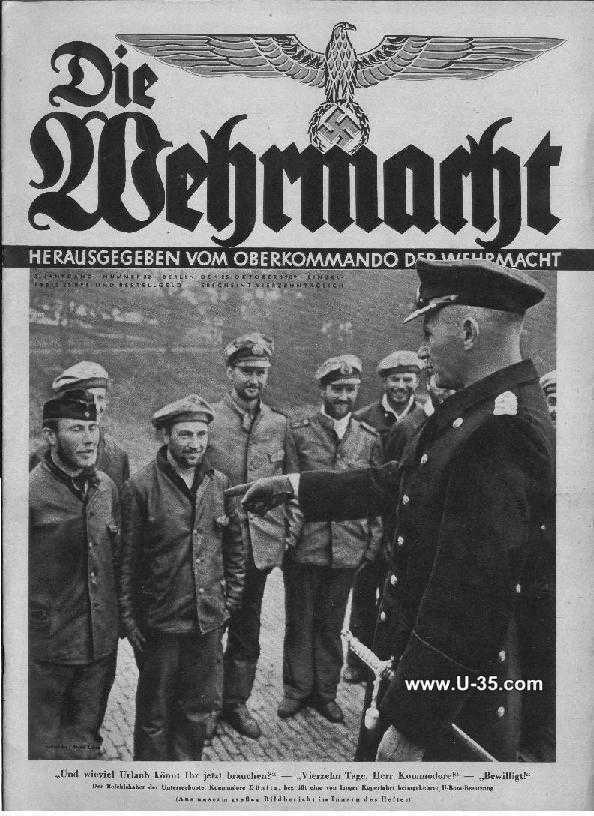 Admiral Karl Dönitz addressing the crew of U-35:
Paul Fichte, Rockenfeller,
Willi Jacob, Heinz Pfeifer,
Richard Friedrich Lüneburg, Gustav
Horstkötter [33,cover photo of 32]
Admiral Karl Dönitz addressing the crew of U-35:
Paul Fichte, Rockenfeller,
Willi Jacob, Heinz Pfeifer,
Richard Friedrich Lüneburg, Gustav
Horstkötter [33,cover photo of 32]
 This group photo of the crew of U-35 was featured on the back cover
of "Die Wehrmacht" (25 October 1939) upon return from the first war patrol.
[32,33]
This group photo of the crew of U-35 was featured on the back cover
of "Die Wehrmacht" (25 October 1939) upon return from the first war patrol.
[32,33]
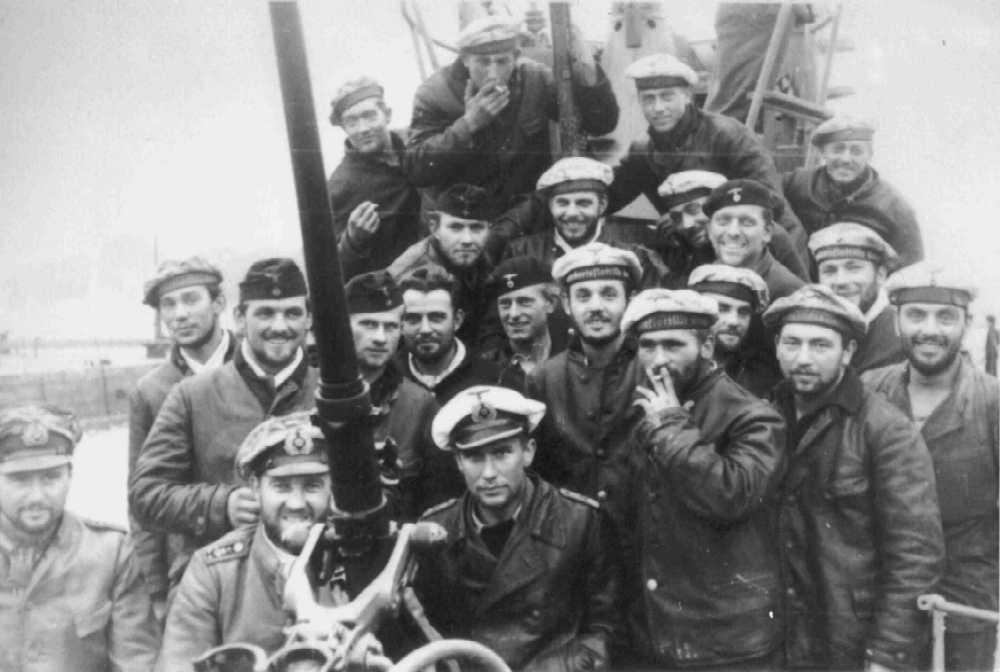 Another photograph taken of the U-35 crew at that time. [35]
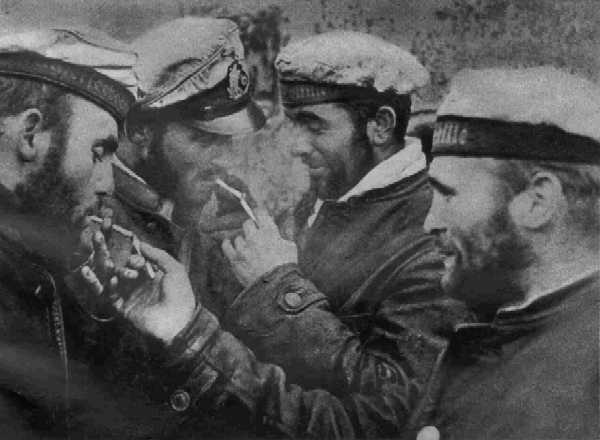 Johannes Weigand,
Richard Friedrich Lüneburg, Karl Schnute,
and Ernst Wensorra. [32,33]
Johannes Weigand,
Richard Friedrich Lüneburg, Karl Schnute,
and Ernst Wensorra. [32,33]
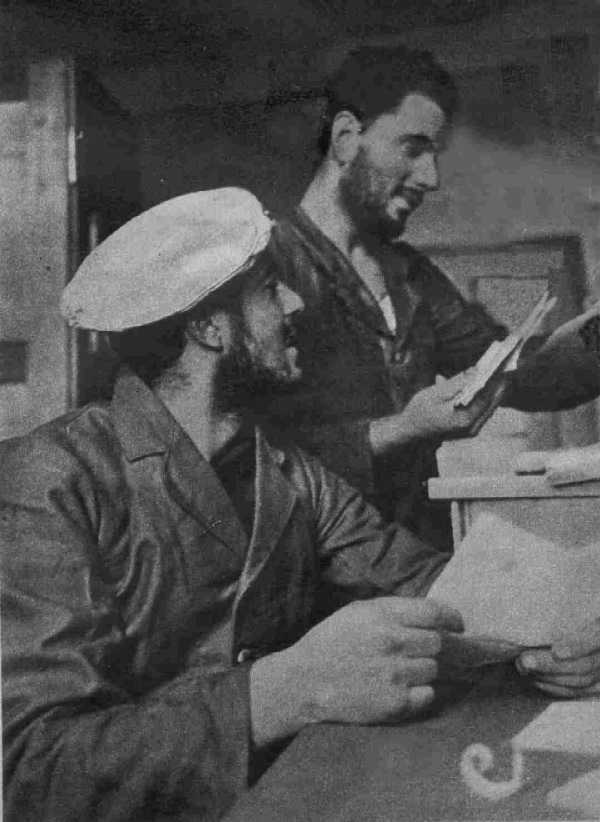 Paul Liebau and
Gerhard Oppermann [32,33]
Paul Liebau and
Gerhard Oppermann [32,33]
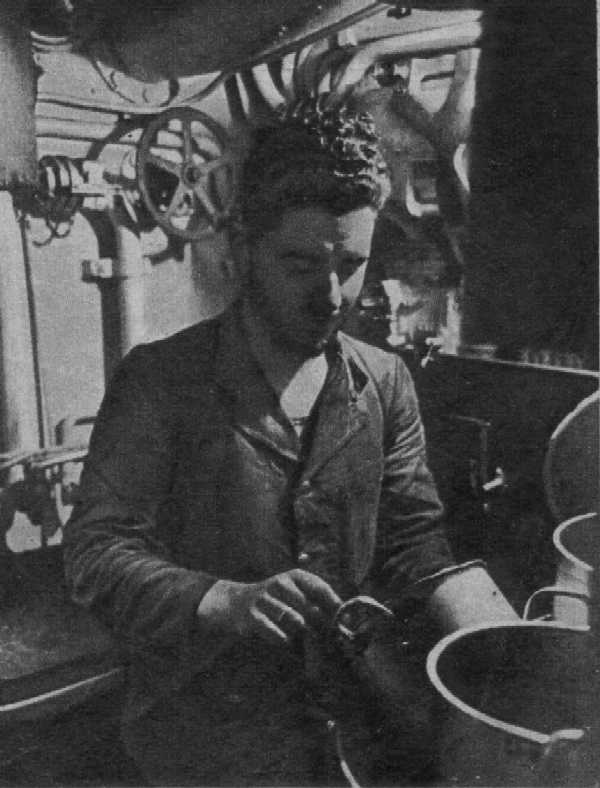 This is the U-Boat's galley! The cook has three small heaters to serve the
crew
This is the U-Boat's galley! The cook has three small heaters to serve the
crew
Shown is not the cook, Martin Müller, but
Gerhard Oppermann [32,33]
Second War Patrol
18 November 1939 - 29 November 1939.
U-35 left Wilhelmshaven for operations against British naval
forces near the Orkneys. After a few days
U-35 moved north from the Pentland Firth to Fair Isle Passage.
Patrolling on the surface in huge seas on 28 November sixty miles east of
Shetland Islands,
U-35 saw the heavy cruiser HMS NORFOLK and broke radio silence to
report her. Twelve miles northeast, U 47 (Günther Prien) picked up
the message and plotted a course to intercept.
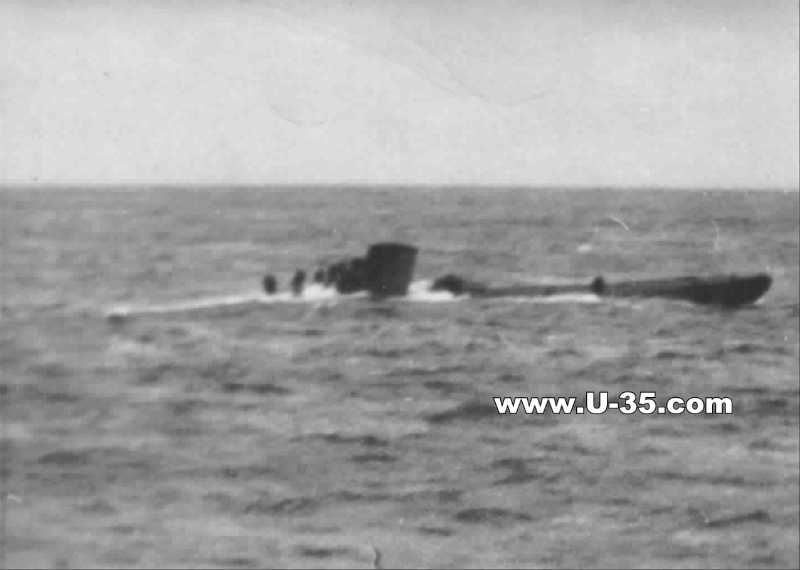 U-35
being abandoned by its crew, as photographed by Able Seaman Ray Cole
aboard HMS KASHMIR. [60]
U-35
being abandoned by its crew, as photographed by Able Seaman Ray Cole
aboard HMS KASHMIR. [60]
An examination of documentation found on the survivors, in particular a diary
kept by a stoker which listed battery levels throughout the night of 28/29
November, led the British to conclude that U-35 was about to enter
Scapa Flow
or Sullom Voe since otherwise she would not have spent the night dived.
[37]
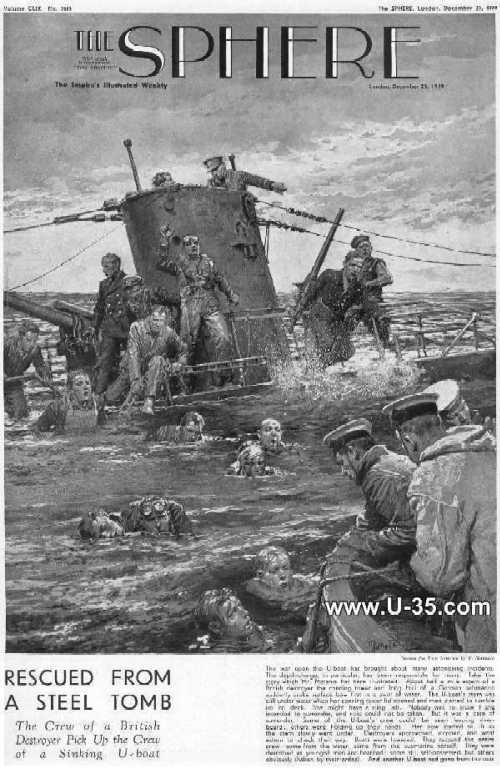 The sinking of U-35 was featured on the cover of The Sphere on
23 December 1939.
The sinking of U-35 was featured on the cover of The Sphere on
23 December 1939.
"RESCUED FROM A STEEL TOMB
The Crew of a British Destroyer Pick Up the Crew of a Sinking U-boat
The war upon the U-boat has brought about many astonishing incidents. The
depth-charge, in particular, has been responsible for many. Take the story
which Mr. Matania has here illustrated. About half a mile astern of a
British destroyer the conning tower and long hull of a German submarine
suddenly broke surface bow first in a swirl of water. The U-boat’s stern was
still under water when her conning tower lid opened and men started to
tumble up on deck. She might have a sting left. Nobody was to know if she
intended to surrender, and risks could not be taken. But it was a case of
surrender. Some of the U-boat’s crew could be seen leaping overboard; others
were holding up their hands. Her bow started to lift as the stern slowly
went under. Destroyers approached, stopped, and went astern to check their
way. Boats were lowered. They rescued the entire crew - some from the water,
some from the submarine herself. They were described as youngish men and
bearded; some still self-possessed, but others obviously shaken by their
ordeal. And another U-boat had gone from the seas."
The German Naval leadership entered the following in its log (Kriegstagebuch) on
04 December 1939:
"U-35" (Kaptlt. Lott) meldet sich nicht mehr auf Anruf. Mit der Möglichkeit
seiner Vernichtung muß leider gerechnet werden. Engl. Meldung spricht von
Versenkung eines Ubootes in der Nordsee, wobei 5 Offiziere und 38 Mann in
Gefangenschaft geraten sein sollen. ("U-35" (Kaptlt. Lott) no longer
responds to calls. The possibility of its destruction must unfortunately be
considered. An English transmission reports the sinking of a U-Boat in the North
Sea, in which 5 officers and 38 men were taken Prisoner.)
and on 12 December 1939:
Der bereits vermutete Verlust von "U-35" (Kapitänleutnant Lott) wird durch
ein Bild des Kommandanten in einer dänischen Zeitung bestätigt. Damit ist das
achte Boot in Verlust geraten. (The presumed loss of "U-35" (Kapitänleutnant
Lott) is confirmed through a picture of the commander in a Danish newspaper.
This is the eighth boat lost.) [1]
* From the book Embleme, Wappen, Malings Deutscher U-boote 1935-1945
(Georg Högel): According to a British sailor who witnessed the event from one of
the Destroyers, Werner Lott had secured himself
to the conning tower and was going to go down with the ship, but two crewmen cut
him loose. I have been unable to confirm this incident; in fact,
Willi Jacob insists that it is not true.
The story continues as the crew members become Prisoners of War
…
The wreck of U-35 was located in July 1986 on the Viking Bank by a
Norwegian remotely operated submersible. [11]
Seeking any additional information and
pictures related to U-35
URL: HTTP://WWW.U-35.COM
© 1999-2021  (relative of
U-35 Chief Engineer Gerhard Stamer)
(relative of
U-35 Chief Engineer Gerhard Stamer)